How to use images and figures in a thesis or written work? Can an image from an article be copied and used as is? How do copyright law and data protection relate to images? Here are basic guidelines for using images.
Contents of the guide:
- Protection of photographs under the Copyright Act
- Using your own photographs and personal data
- Can a student take images and figures for a thesis without asking for permission?
- When is the threshold of originality exceeded?
- Rights that allow you to use photographs, figures and tables made by others
- Use of figures and images based on the right to quote
- Checklist for quoting
- If I draw a corresponding image/figure myself, do I then need permission from the original author?
- Open image archives and CC license
- Asking for permission to use an image
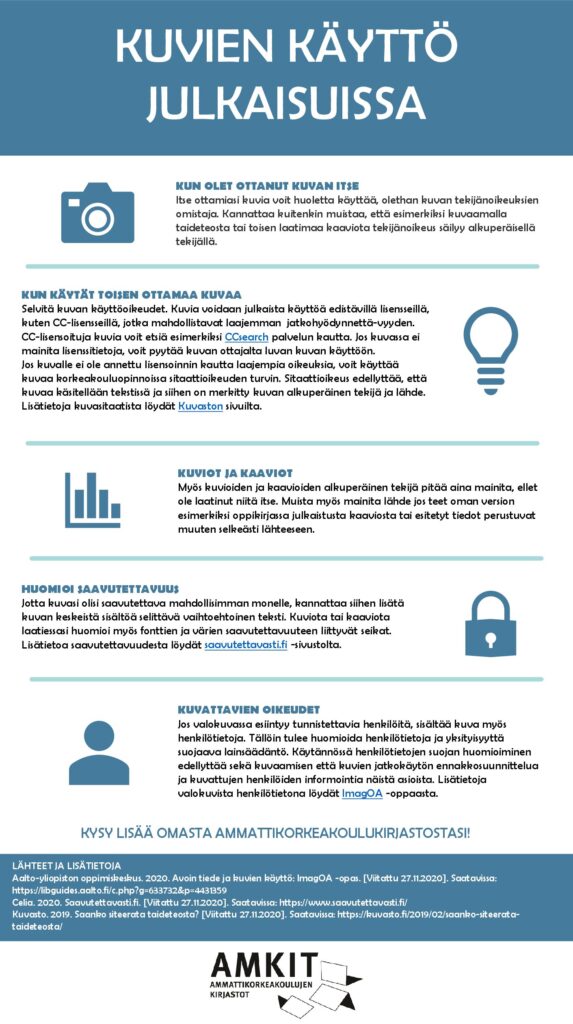
- Image use in publications – infographic
The use of copyrighted material requires permission. Such material includes, for example, various photographs, drawings, maps and photographs. If your research data consists of images and you intend to include images in your thesis, determine well in advance whether this is allowed.
Copyrighted material may not be used in a thesis without permission. Such material includes, for example, various photographs, drawings and maps (Copyright Act 1 § 49a §)
Protection of photographs under the Copyright Act
All photographs are protected under the Copyright Act, unless the protection period has expired or the economic rights have been waived, e.g. by CC0 relinquishment:
- Ordinary photographs, Copyright Act 49a §: protection period 50 years from the end of the year of creation.
- Photographic works, Copyright Act 1 §: protection period 70 years from the author’s death.
Using your own photographs and personal data
Remember that photographing and publishing images are two different things. As a rule, you cannot share or publish images or videos taken in, for example, a project or thesis-related workshop on social media, websites, publications or video sharing services without the consent of the person photographed.
If you take photographs yourself that include identifiable persons, they contain personal data. When photographing and publishing such photographs, you must take into account privacy and data protection legislation. The most important regulation dealing with personal data protection is the data protection regulation. Privacy and personal data protection are also addressed in several national laws and the Criminal Code.
When images are to be used in a thesis, publication or project, those photographed must be informed about the photographing and the use of the images and consent must be obtained if necessary. Inform in advance about the photographing and its purposes. Those photographed must know where the images will be used so they can decide whether to consent to being photographed. Explain whether the intent is to photograph individual persons or to take general photos of a workshop and its outputs. If a person or their work is identifiable in the images, obtain a photography consent.
At public events, notice about photographing and image use can be provided, for example, at the time of event registration. Registration may need to include data protection regulation-compliant information about the use of identifiable persons’ images. In this way, the use and publication of images are planned in advance. At the event, it is possible to designate an area of the event for those who do not wish to appear in photos. Refusal to be photographed must not cause participants any disadvantage. For photography consent, you can, if necessary, use the Laurea media agreement template. Consent for photographing can also be requested as part of a common list. For this, Laurea’s Consent for workshop and processing of personal data template can be used. If people cannot be identified from a photograph, a separate photography consent is not required. More information is available in Aalto University’s ImagOA guide.
Can a student include images, tables or figures from various sources in their thesis without permission?
When using photographs or other images that exceed the threshold of originality, permission must be requested from the photographer, the image author or the publisher, and it should be stated alongside the image that the image is used with the author’s or rights holder’s permission.
If more than 70 years have passed since the author’s death, the copyright has expired and the image may be used without a separate permission.
A figure or table that does not exceed the threshold of originality may be used when the original author and source are named (i.e., on the basis of the so-called right to quote).
When is the threshold of originality exceeded?
Copyright does not protect information or ideas but the form of expression. Generally, exceeding the threshold of originality requires independence, originality and creativity in the expression. Even if these criteria are not met, neighbouring rights may protect a work, for example in the case of photographs.
Usually technical drawings, tables and diagrams do not reach the level of a work, but good scientific practice often includes asking for permission also in these cases. The original author and source must be mentioned even when using images that do not exceed the threshold of originality.
More information on when the threshold of originality is exceeded can be found in the Copyright Council’s opinion 2012:1.
Rights that allow you to use photographs, figures and tables made by others
You can use in your publication images and tables that exceed the threshold of originality on the following alternative grounds:
- An image whose copyright or protection period has expired. In Finland, ordinary photographs are protected for 50 years from the end of the year in which the photograph was taken. In some cases (for example artworks), the protection period may be 70 years from the author’s year of death.
- With the author’s permission: You can request permission to use an image or figure directly from the author or rights holder. This is especially important when the image has not been published.
- Under a CC license: The CC license and the name of the original creator must be indicated alongside the image or figure. More information about CC licenses below.
- Based on the right of quotation: A photograph, drawing, graph or table made by someone else may be included in a thesis or scientific publication if certain conditions are met. See the conditions below on this page.
Always cite the source! Note that when using material made by others, the author and the source must always be mentioned both alongside the image or figure and in the reference list. If you have not acknowledged the origin of someone else’s image or table, this may constitute plagiarism and have consequences.
Use of figures and images on the basis of the right to quote
The right to quote (also called quotation right) is an exception to copyright defined in Section 22 of the Finnish Copyright Act (link), which states that “it is permitted to make quotations from a published work in accordance with fair practice and to the extent required by the purpose”. According to image quotation rights (Copyright Act 25 §) “from published works of art, images relating to the text may be taken for purposes of criticism or scientific presentation”. When using the right to quote, the quoted work and its author must be indicated; otherwise, the quotation may be considered plagiarism or a copyright infringement even if the conditions of the right to quote are otherwise met.
Checklist for quoting
Here are the conditions under which an image, figure or table may be used in your thesis or scientific text under the right to quote. Consider whether these apply in your own work.
- Quotations may be taken from published works. A work is considered published when it has been lawfully made available to the public.
- The quoted image, figure or table must relate to the matter discussed in your own text; it must be discussed in the text (main text, not only in the caption) and the quotation must be justified in terms of the content of the work. In other words, the image or figure must have a substantive connection to your text. Using it merely as an illustration is not permitted.
- The text must be a critical or scientific presentation and the purpose non-commercial. Use in a university thesis is non-commercial use.
- Quotations may be taken to the extent required by the purpose.
- The quotation must indicate the author and source.
If the conditions for quotation are not met, the student can request permission from the rights holder to use the image in the thesis or use images licensed under, for example, a CC license. If you are not sure whether the use of the image is permitted under quotation, ask the author for permission to use the image.
Mark images used under the right to quote as sources both in the caption and in the reference list. Often a better way to use a figure is to redraw the same image instead of a screenshot and cite the sources. If changes are made to the image, indicate that the image is adapted from the original source.
If I draw a corresponding image/figure myself, do I then need permission from the original author?
Yes, you need permission if the original image/figure exceeds the threshold of originality, because drawing the image following the original model is a reproduction for which permission must be sought. However, if you draw an entirely new image that cannot be associated with the original, permission is not required.
Open image archives and CC license
There are many images on the web licensed under open Creative Commons licenses. Image collections are available on a wide range of topics and many large memory organisations’ databases contain Creative Commons-licensed material that is easy to use in studies or research.
Aalto University’s ImagOA guide contains a comprehensive list of open image archives. When using an image, remember to indicate the creator and the license under which the creator permits the use of the image.
Asking permission to use an image
Permission to use images in articles and books is most often requested from the publisher rather than the article’s author. The article may include a link (e.g. Request Permission, Get rights and content) that leads to services such as RightsLink where you can request permission to reuse images. It is recommended to use the service provided with the article. However, it is always advisable to first check whether the author has already granted permission for the use of the image, for example under a CC license.
Image use in publications – infographic