
Baltic2Hand – As good as new: Enhancing the behavioral and business change of the second-hand textile industry in the Central Baltic region
The aim of the Baltic2Hand project was to improve the reuse of textiles and reduce textile waste in the textile market. The project involved fashion and textile industry organizations from Latvia, Sweden, Finland, and Estonia. Within the project, we co-created solutions for both profit and non-profit organizations to include a second-hand operation into their business model, to boost second-hand operations and/or to include other types of circular operations into their business.


Context and problem:
Every piece of fabric tells a story — yet far too many of those stories end prematurely. In the EU, an average of 12 kilograms of textile waste is generated per person each year, amounting to nearly 5 million tons annually, while only about 1% of textile waste is recycled (European Commission 2026). In Finland alone, people purchase an average of 38 new clothing items per year (Finnish Textile and Fashion 2022), far exceeding a sustainable level of approximately five items (Coscieme et al. 2022).
Thus, there was a need to our project which aimed at improving textile reuse, reducing textile waste and promoting consumer use of second-hand textiles within the Central Baltic region in Finland, Sweden, Estonia and Latvia.
Idea and solution:
The project followed a service design process offering industry-tailored co-creation activities for textile sector organizations and key stakeholders. The aim was to generate common development ideas and convert them into concrete solutions within participating companies.
Firstly, the focus was on analysing market conditions, consumer behaviour, and company needs. Based on the findings, a series of webinars, events, and workshops were offered later in the process to target companies and organizations to build initial understanding and readiness for development.
The first phase was followed by the creation of new ideas and concepts through cross-border and local ideation workshops. Next, the focus was on company-specific development needs. Prototypes were created and tested with companies committed to the process. The final phase consisted of piloting of solutions, which some of the companies already implemented.
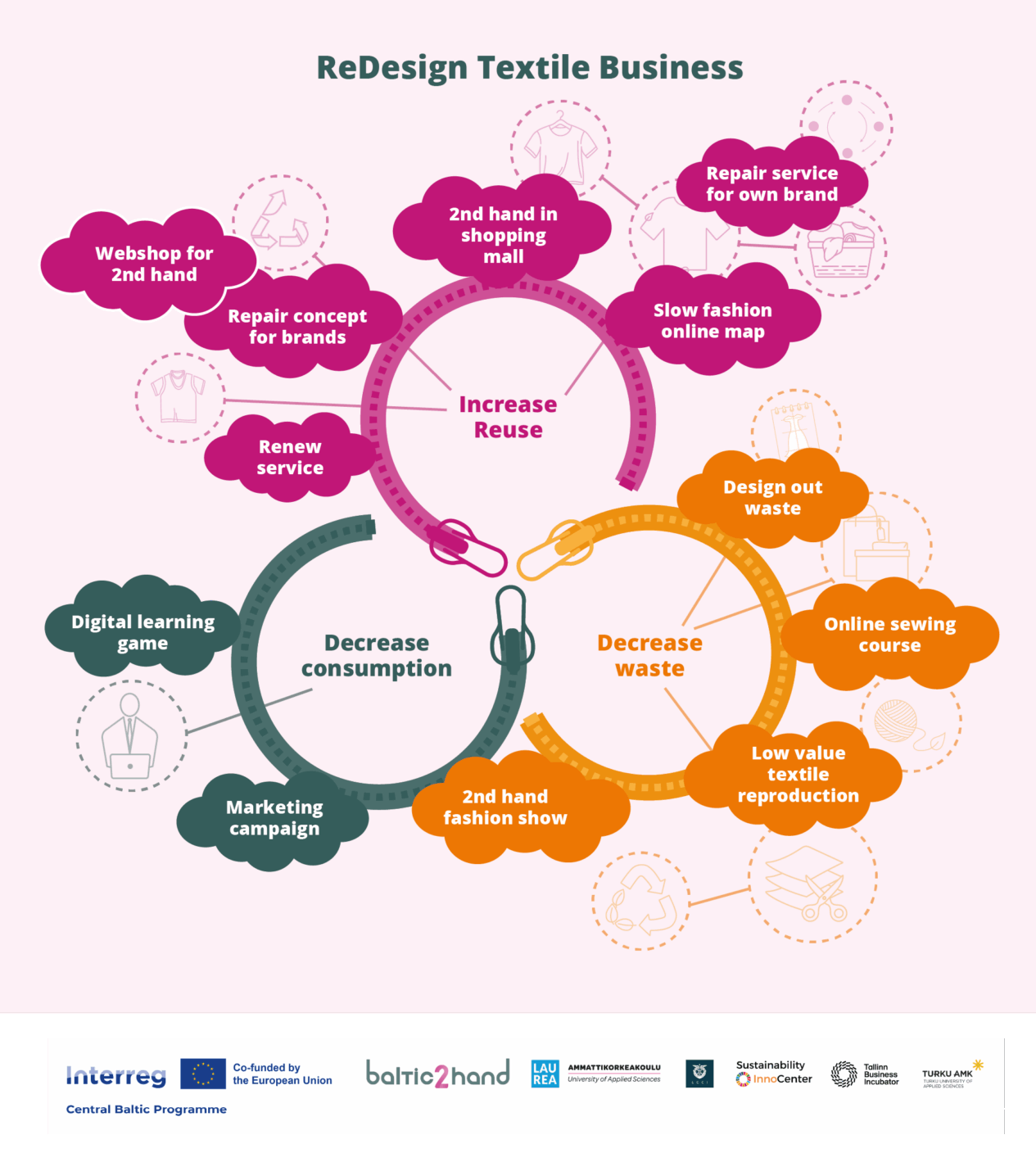
Content creation: the Baltic2Hand team and Mama Creative; production: Mama Creative
Implementation and impact:
Close cooperation among project partners significantly accelerated collaborative learning and knowledge exchange. In this project, it was particularly important that the partnership represented a multidisciplinary composition, including not only universities of applied sciences, but also accelerators and business support organizations.
This diversity strengthened the practical relevance of the project outcomes and supported effective knowledge transfer between academia and industry. Circular economy knowledge and awareness were strengthened through a systemic understanding of the circular textile value chain.
Project figures:
• 59 companies participated in the project activities
• 12 idea cards about customer engagement, textile collection and reuse
• 12 prototypes tested
• 6 cross-border pilots completed
• 7 local pilots were completed
• 9 companies implemented solutions.
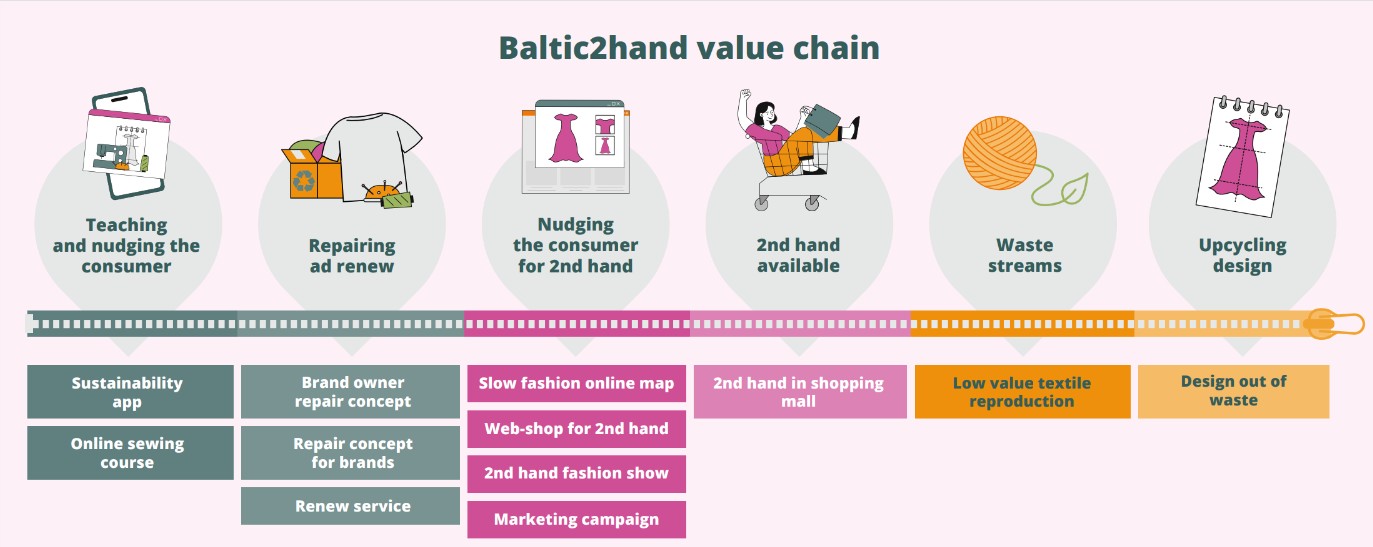
The figure illustrates Baltic2Hand value chain. Content by Baltic2Hand team, visual execution by Ilona Potinoja / KMG Turku
References:
Coscieme, L., Akenji, L., Latva-Hakuni, E. & Goodwin, K. 2009. Designing for the Digital Age. How to Create Human-Centered Products and Services. Indianapolis: Wiley Publishing, Inc.
Finnish Textile and Fashion 2022. Vaatteiden ja kodintekstiilien kuluttajamarkkina Suomessa ja Euroo-
passa.
European Commisson. 2026. Sustainable and Circular Textiles Strategy. Textiles Strategy – Environment – European Commission
Funder

Project information
Implementation time
1.4.2023-31.3.2026
Funder
Interreg Central Baltic 2021-2027
Research programme
Project type
Themes
Project Manager
Salla Kuuluvainen
Sustainable development goals
Contacts
-
Salla Kuuluvainen
Specialist
You may also be interested
-
Agents of Change–Unhurried Horizons: The Future of Slow Tourism
Implementation time:
1.2.2025 – 31.1.2028
Read more: Agents of Change–Unhurried Horizons: The Future of Slow TourismResearch programme:
Service Business and Circular Economy -
CargoRes – Sustainable Handling of Cargo Residues
Implementation time:
1.9.2025 – 31.8.2028
Read more: CargoRes – Sustainable Handling of Cargo ResiduesResearch programme:
Coherent Security