News
–
The NEPTUNE project coordinated by Laurea strengthens Europe’s submarine cable resilience
The NEPTUNE project coordinated by Laurea began with a kick-off event held in Helsinki in early September. The project focuses on strengthening the security, resilience and operational reliability of submarine cable infrastructure. Cooperation for European undersea security Submarine cables are a central part of Europe’s critical infrastructure. Geopolitical tensions, accidents and technical failures have increased…
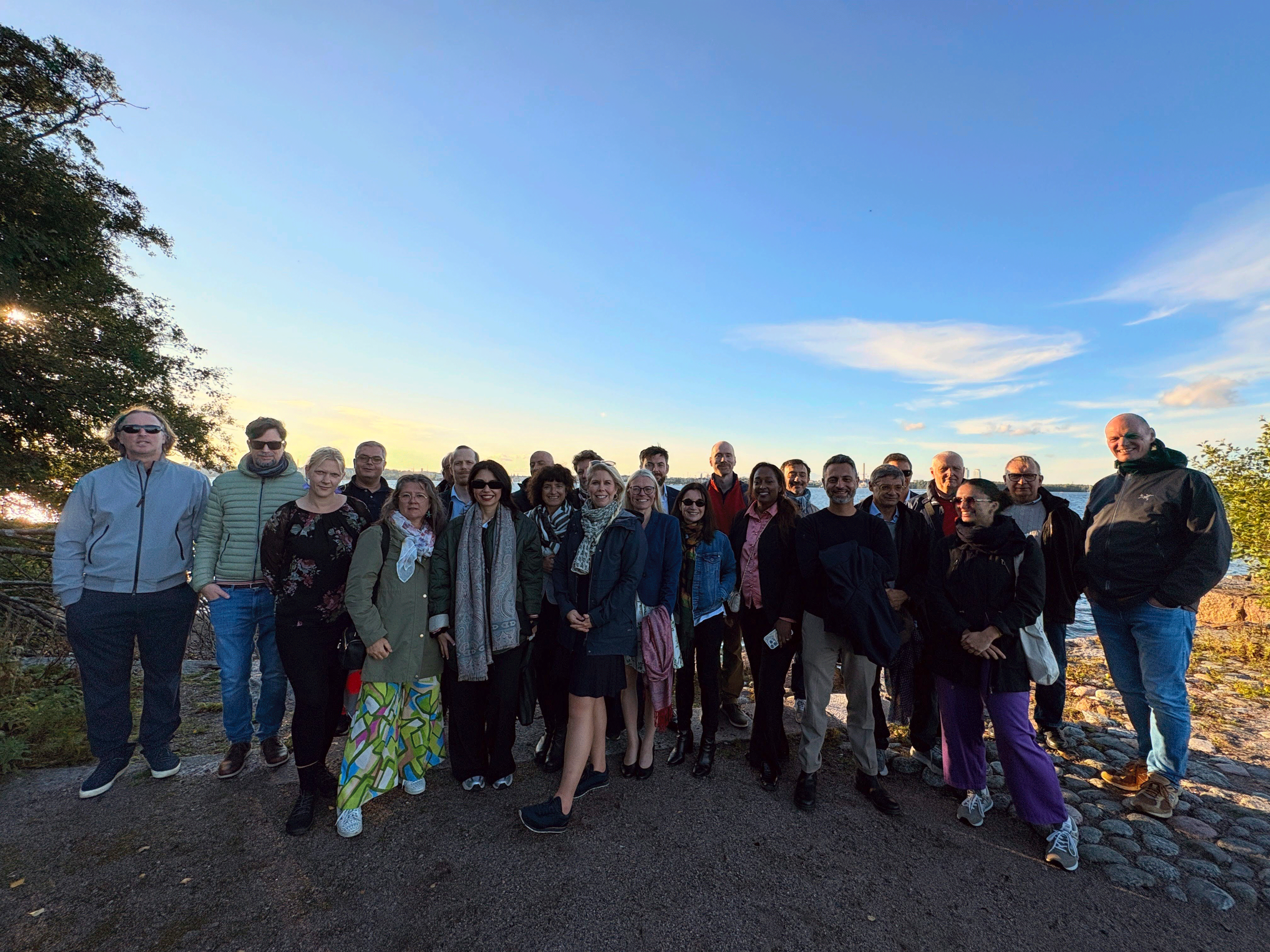
The NEPTUNE project coordinated by Laurea began with a kick-off event held in Helsinki in early September. The project focuses on strengthening the security, resilience and operational reliability of submarine cable infrastructure.
Cooperation for European undersea security
Submarine cables are a central part of Europe’s critical infrastructure. Geopolitical tensions, accidents and technical failures have increased the need to enhance cable protection and to improve preparedness for disruptive incidents.
The NEPTUNE project addresses this challenge by building a pan-European research and innovation agenda for developing cable infrastructure. The project, funded by the EU’s Horizon Europe research and innovation programme, involves fifteen organisations from eight European countries.
NEPTUNE examines Europe’s needs across three time horizons: short-term goals up to 2030, mid-term goals up to 2035 and longer-term needs towards 2045 and beyond. The work focuses on technology, research and investment needs, as well as governance and cross-sector collaboration.
Laurea expands its expertise in critical infrastructure research
NEPTUNE is Laurea’s second Horizon Europe project focusing on critical undersea infrastructure. The ongoing VIGIMARE project develops and tests practical solutions for, among other things, surveillance, risk assessment and anomaly detection. NEPTUNE, in turn, looks to Europe’s long-term research, innovation and investment needs.
– “NEPTUNE is a natural continuation of the work we have been doing at Laurea in the field of critical undersea infrastructure. VIGIMARE has given us valuable experience and networks. Now we can build on that foundation and at the same time consider what Europe will need in the coming decades,” says Laurea’s leading expert Johanna Karvonen, who coordinates both projects.
“We are not starting from zero” – expertise must be brought together
The project’s opening event brought together perspectives from authorities, cable operators, industry, researchers and decision-makers from various European countries to Helsinki. The discussions emphasized the importance of information sharing, coordination and situational awareness below sea surface.
Resilience of Europe’s undersea infrastructure does not mean only reacting and repairing damaged cables. It is made up of prevention, detection, preparedness, effective response and recovery. In practice, this requires expertise, equipment, repair capacity and secure ways to share information between states and organisations.
– “We are not starting from zero,” reminded the European Subsea Cables Association’s executive director John Wrottesley. “There is already a great deal of expertise and functioning initiatives in Europe. The next task is to connect them and identify the remaining gaps in the whole picture.”
For Laurea, a key strength of the project is its European cooperation network.
– “Working with operators, authorities, industry, researchers and policymakers gives us a much better understanding of what is needed in practice – and that is essential if research and innovation are to lead to solutions that can actually be used,” Karvonen says.
Contact details
-

Johanna Karvonen
Special Advisor
johanna.karvonen@laurea.fi
+358 40 708 5599
News