Article
–
Cybersecurity is also a matter of patient safety – four solutions for everyday work in the social and healthcare sector
Cybersecurity is not just an IT issue: four new solutions help healthcare and social care professionals protect patient data and safeguard service continuity in their daily work.
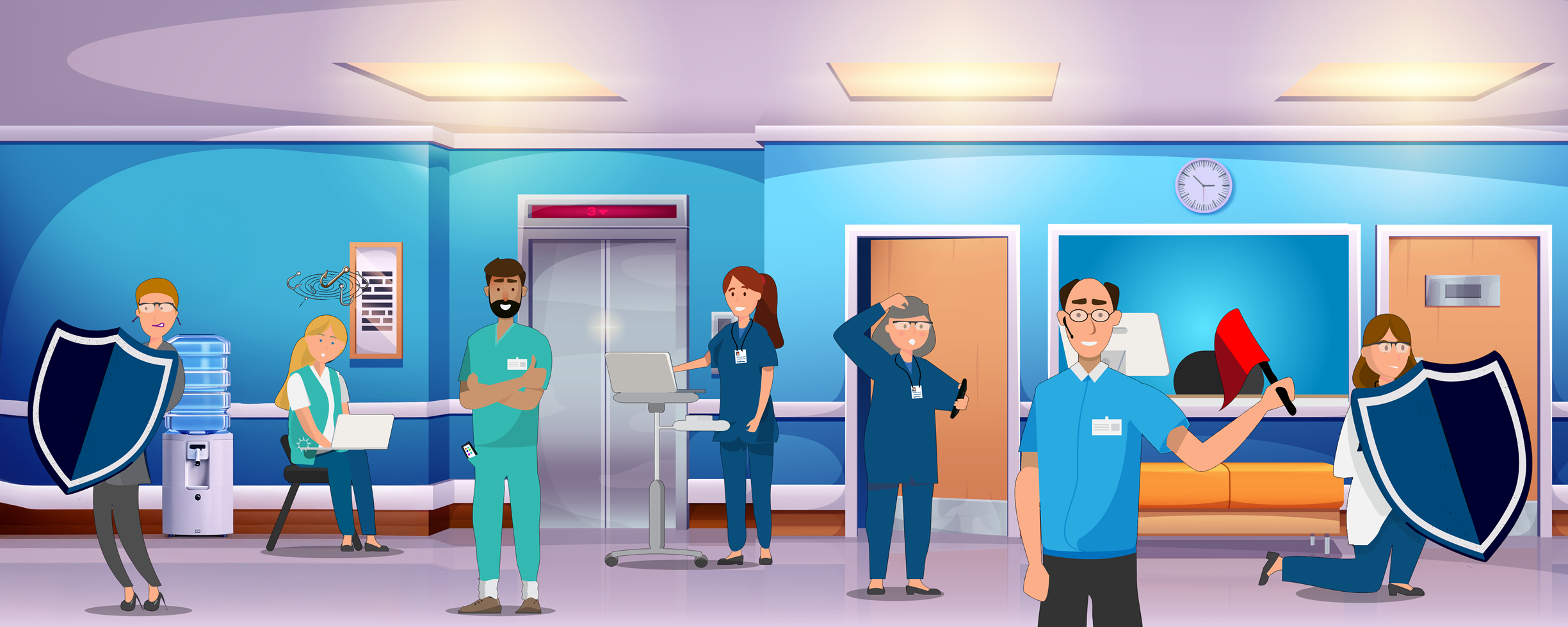
Phishing messages or careless use of credentials can endanger the continuity of social and health services as well as client and patient safety. As social and health care becomes digitalised, cybersecurity increasingly becomes part of every professional’s everyday work. Security is also built in everyday situations: in how messages are responded to, how credentials are used and how confidential information is handled.
In the KyberSoTe project, funded by the National Emergency Supply Agency’s Digital Security programme, Laurea developed, together with the Jyväskylä, Tampere and Turku universities of applied sciences and five wellbeing service counties, four practical solutions that help strengthen cybersecurity in the social and health sector. The free materials are available for organisations to use.
From ten threat scenarios to practical solutions
The project initially identified ten typical cyber threat scenarios. Based on these, four solutions tailored to the social and health sector were developed to support staff competence and organisations’ ability to prepare for cyber threats:
- Cyber agent operating model brings support close. Cyber agents are trained members of staff who help their work community with information and cybersecurity-related questions.
- Online training helps identify everyday risks. The training aimed at social and health professionals and teachers addresses cyber risks in work situations and their impacts.
- Interaction development model strengthens collaboration. The model supports interaction between social and health professionals and ICT specialists.
- Competence mapping survey helps target development. It enables organisations to assess staff’s information and cybersecurity skills and to identify development needs.
The free materials and freely usable tools can be found on the KyberSoTe project website.
Teachers’ expertise strengthens the preparedness of future professionals
Laurea’s experts participated in the project particularly in developing safety culture, competence and practical operating models. One of the project’s outputs is an online training package that strengthens the cybersecurity competence of teachers in the social and health sector. Through teachers, knowledge and safe practices become part of teaching. This way, future social and health professionals gain skills to recognise cyber threats and to act safely already during placements and later in working life.
A key finding of the project was that cybersecurity requires competence and cooperation throughout the entire work community. Every professional’s practices affect how well clients’ data are protected and how service continuity is secured.
Join the conversation about safer everyday social and health care on 12 November
What does cybersecurity in the social and health sector look like now, and how can future threats be prepared for? The KyberSoTe project’s final event Together for safer everyday social and health care brings together up-to-date information, practical solutions and a discussion on the needs of the social and health sector.
The event will be held on 12 November 2026 from 9:30 to 16:15 at the premises of Jyväskylä University of Applied Sciences, Piippukatu 2, 40100 Jyväskylä. Participation is also possible remotely.
Contact information
-
Annika Kallio
Senior Lecturer
annika.kallio@laurea.fi
+358 50 406 4226
News