About us
Sustainable education activities
Laurea’s sustainable education activities aim for those studying and who have studied at Laurea to be known as solution-oriented experts in sustainable development and the circular economy and as renewers of working life.
Our degrees and courses
The Master’s degree programme in Sustainable Growth Management (YAMK) started at Laurea in autumn 2020. The programme focuses on sustainable development, sustainable growth and the circular economy. During the studies, a new growth paradigm for sustainable growth is created through practical activities. Growth is examined in the courses from the perspectives of the individual, the company and society as a whole. Read more about the Master’s degree programme in Sustainable Growth Management on Laurea’s website.
Maria Ekström’s article describing the development of the programme, “Building a more sustainable business realm through education”, is available on Theseus.
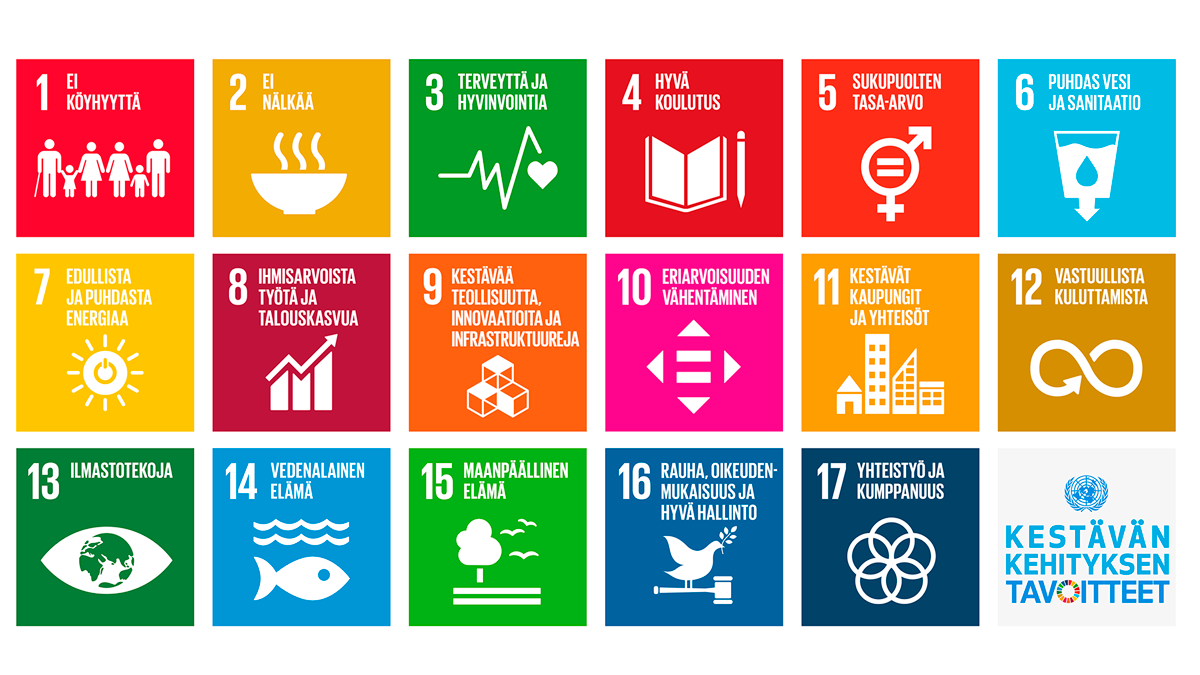
The above UN Sustainable Development Goals (Sustainable Development Goals, SDG) are a globally recognised framework for promoting sustainable development and appear widely in Laurea’s educational activities. Below you can explore in more detail how the Sustainable Development Goals are linked particularly to physiotherapy, business, hospitality (restonomi) and public health nurse education.
Physiotherapy education
SDG 3: The goal is taken into account in course contents, internships and various projects. Themes related to healthy living and well-being are a central part of the education.
Also SDG 8 (decent work and economic growth) is visible in the studies: On the Service Design and Entrepreneurship course for the wellbeing sector new kinds of services are developed and skills related to new forms of entrepreneurship are strengthened. Various project studies also support this goal.
SDG 11: Themes related to accessibility and barrier-free design appear in health and functional capacity promotion themes and in defining goals related to the client’s everyday life.
SDG 13: The studies include competence in digital rehabilitation services and the development of new electronic services more broadly.
Business education
In business education the circular economy has been integrated into the core studies common to all students. Read more about the integration work and process in the Laurea Journal article
Hospitality (restonomi) education
SDG 2: Local and organic food, nutrition, and food waste themes are linked to many parts of the hospitality education and are an integral part of the daily operations of the teaching restaurant BarLaurea.
SDG 7: Part of BarLaurea’s operations is to find energy-efficient solutions for operations and equipment purchases.
SDG 8: Partnership cooperation, company projects and student internships
SDG 9: The programme’s project activities, e.g. Mission Zero Foodprint and Ruokaa Luonnosta.
SDG 12 and 13: Organic and local food and new food production methods.
SDG 14: The use of fish and especially so-called ‘trash fish’ in food preparation at the BarLaurea teaching restaurant.
SDG 17: Consideration of sustainable development in all activities, also globally in project activities.
Public health nurse education
SDG 1: Poverty here does not mean only lack of living standards but also e.g. malnutrition and lack of education or health care. Public health nurse studies include health promotion projects where the target groups are, for example, children, young people and the elderly.
SDG 2: Public health nurse studies include nutrition-related health promotion projects aimed at, for example, children, young people and the elderly.
SDG 3: Almost all contents of the public health nurse education, internships, projects etc. relate to this goal. Themes related to healthy living and well-being are a central part of the education.
SDG 4: Strong workplace skills and readiness for continuous learning are emphasised in the contents and implementation methods of the public health nurse education.
SDG 5: The public health nurse education includes sexual and reproductive health studies as projects, internships and within courses. Participation, influence and leadership skills are developed through voluntary activities included in the studies, other projects, internships and leadership studies.
SDG 8: Entrepreneurship studies and project studies develop entrepreneurial skills. The education includes studies in environmental health and health of the working-age population, and leadership studies develop, for example, cost-effectiveness, work environment and community skills.
SDG 10: Ethics studies develop students’ competence in equality. All students participate in voluntary activities during their studies and thereby gain experience in participation and influence.
SDG 11: Themes related to accessibility and barrier-free design appear in health and functional capacity promotion themes. The degree includes studies in environmental health.
SDG 12: Practices seek to find solutions in line with sustainable development, e.g. recycling of practice supplies used for training. The number of paper printouts in online teaching has decreased.
SDG 13: An increasing proportion of studies are completed online, which reduces travel between home and the institution. The studies include competence in digital health services and the development of new electronic services more broadly.
SDG 16: Leadership and project studies develop participation and influence skills and the ability to develop one’s own work community.
Other programmes
In computing education themes related to the Sustainable Development Goals are connected to IT infrastructure, networks, information security and cybersecurity linked to the SDG 9 objective. The AMKoodari studies offered in the open university of applied sciences also support the SDG 4 objective of lifelong learning opportunities.
In the bachelor of social services education sustainable development themes and goals are visible in several core study modules, such as wellbeing and participation, service systems, etc. The goal of reducing inequality also emphasises a strong international perspective. Also read Tiina Wikström’s Laurea Journal article on social and cultural sustainability in the bachelor of social services education
In cosmetology education the Management Skills course addresses several sustainable development goals both in terms of content and competence objectives. The “Cosmetics industry and career from a Nordic perspective” course delves into responsibility in international purchasing, and the complementary competence “Cosmetic Brand” course has the competence objective of applying sustainable development principles and considering them in, for example, packaging material choices. Additionally, the Raw Materials Knowledge course explores cosmetics by-products and their potential uses.
Integration of teaching and RDI supports the implementation of the theme into education
- The integration of teaching and RDI took the form, for example, of the Horizon 2020 funded CIRC4Life project which commissioned the thesis of Suvi Seikkula, who studied Service Design in the YAMK programme. The thesis focused on co-creation and circular economy business models. Read Suvi Seikkula’s thesis on Theseus. An article written on the basis of the thesis, “MIND THE GAP: Understanding and communicating the business value of co-creation”, was awarded the best research paper at the Digital Open Living Lab Days conference. Read more about integrating this project into teaching in the Laurea Journal article.
- Results from circular economy projects have also been integrated into teaching. The CIRC4Life project produced the CELL toolkit, which can be used as a tool for developing circular economy business models. Students in Laurea’s Master’s programme in Sustainable Growth Management have utilised this toolkit in applying the theoretical basis of a course and in developing circular economy business models. Read more about the CELL toolkit as a learning tool. Learn more about the CELL toolkit
- On the Sustainable Consumer Behaviour course Service Jams have also been organised, the idea of which has been to validate the CIRC4Life project’s demos/business concepts from the consumer’s perspective.
- Laurea participated in the Ministry of Education and Culture’s ‘Circular economy competence for universities of applied sciences’ project in 2018-2020. In the project, together with other universities of applied sciences, a service design course and teaching materials for circular economy were developed for business students. The project resulted, for example, in the “Circular Economy in Service Design” course, which focuses, as the name suggests, on circular economy service design. Read more about the course and its development in the Laurea Journal article.
We have compiled Laurea-related education, research and development work, and regional development related to sustainability, responsibility and the circular economy into Laurea’s Circular Economy Living Lab. The Living Lab serves as a collaboration platform and a learning and development environment for students, teachers, staff, partners and international networks, both online and on campus.
For more information contact
-
Katri Ojasalo
Vice President
katri.ojasalo@laurea.fi
+358 40 736 6253
News
No articles were found for the search terms used.