Laurea Master School
Laurea Master School is designed for professionals and leaders who want to develop their skills and advance their careers flexibly alongside their work.
Learn more about our master's degree programsLaurea Master School in brief
- Duration: 1.5–2.5 years
- Mode of teaching: Flexible blended learning or entirely online
- Eligibility criteria: a Bachelor's or Master's degree + at least 2 years of subsequent work experience
- Degree: Laurea Master School degree corresponds to university master's degree programs.
- Employment rate: 99.3% after completing a Master's degree at Laurea
- Student satisfaction: 91% in 2023
- Willingness to recommend: 81% would recommend Laurea's Master's degree programmes
Laurea Master School programmes offer a flexible and multidisciplinary path to a Master's degree. Our studies offer a work-oriented and multidisciplinary path towards new opportunities, combining theory and practice. Flexible and customisable Master's studies support both professional development and career advancement.
Ambition leads the way, commitment carries you forward – you create your career at Laurea Master School!
Why choose Laurea Master School?
Laurea Master School offers flexible and practical Master's degree programmes that support professional development and career advancement. Based on student feedback, our students particularly appreciate the following:
- Career advancement: ‘I believe that my studies have also helped me advance in my career, and they have clearly developed my analytical thinking skills and provided me with tools for my work.’
- High-quality and expert teaching: “Laurea offers high-quality teaching and a wide range of courses, allowing you to choose the ones that interest you most. Studies and students are supported.”
- Learning by Developing model (LbD): "LbD is an excellent way to learn both skills and the courage to take action. Even if you already have a higher education degree, Laurea's studies offer an excellent opportunity to update your skills to the current day."
- Strong working life cooperation and networking: "In Laurea's studies, I particularly appreciated the expert teaching and the strong link between the courses and real working life development tasks, which enabled the combination of theory and practice in multidisciplinary project teams."
- Flexibility: "Online learning was implemented very well and smoothly in the studies. Combining studies with working life was seamless. The studies were diverse and challenging enough, which enabled individual development as part of future working life."
- Working life projects: "At Laurea, you get to learn through real-life projects!"
Studies at Laurea Master School are built around a clear degree structure
All degrees share a high level of teaching that combines theory and practice. Students can plan their studies by choosing complementary studies from a diverse and extensive range of courses. Laurea's Master's degrees place particular emphasis on working life cooperation and practicality.
The degree (90 ECTS) consists of core competence, freely selectable complementary studies, and a thesis, which you can complete in your own work community or as part of Laurea's RDI projects. The complementary studies are broad in scope, bringing together students from different fields and offering multidisciplinary opportunities for cooperation and networking.
Structure of Laurea Master's degrees (90 credits in total):
- Core competence studies (30 ECTS)
- Thesis (30 ECTS)
- Complementary studies (30 ECTS). Complementary studies can be completed through study modules, projects, demonstrations, or recognition of prior learning.
Find out more about complementary studies
How do Master's degree studies benefit your employer
Laurea Master School offers excellent opportunities to deepen your professional expertise and develop new skills, which also benefits your employer. The studies strengthen your ability to bring new perspectives, innovations, and effective solutions to the work community. Flexible study arrangements allow you to study alongside your work, minimizing the impact on your working hours. Work-based projects and development projects promote the development of operating methods and help you respond to the changing challenges of working life.
- In-depth expertise and advanced skills: You will gain in-depth and up-to-date knowledge in your field and develop your skills in proactive working, self-direction, critical thinking, and problem solving.
- Adaptability and flexibility: Flexible and customizable study options support your adaptability and readiness to respond to the changing demands of working life.
- Promoting innovation and impact: Participation in multidisciplinary projects and work-based initiatives helps you develop new ideas and perspectives, promoting innovation and creating conditions for renewal in your work community.
Discover the theses written by our Master's degree students
What is studying at Laurea Master School like?
At Laurea Master School, studies are designed to be flexible to suit different life situations. It is possible to complete your studies while working, and the duration of studies is 1.5–2.5 years, depending on your individual study plan. You will receive expert guidance and support from a multidisciplinary student community. Learning is based on the Learning by Developing (LbD) model, which enables you to develop your skills through practical work challenges and supports the strengthening of your expertise.
The studies combine practical tasks, working life projects and collaborative learning. Depending on the programme, the studies are carried out either as blended learning or online learning. Classroom teaching in core competence studies averages 1–3 days per month. Classroom teaching days emphasise collaborative learning, workshop work and links to research and development activities. Collaborative learning and applied workshop work require participation in classroom teaching days and virtual contact days. Complementary competence studies are mainly conducted online. Studies may include joint scheduled online meetings.
Community-based contact days, authentic working life projects and the opportunity to participate in international intensive weeks make studying inspiring and meaningful.
What are we known for?
At Laurea Master School, multidisciplinarity is more than just a word – it is a way of learning and developing. Here, experts from different fields meet, network and build new things together. In complementary studies, students from all degree programmes get to work on shared themes, creating genuine interaction, new perspectives and deeper understanding.
Study for a Master's degree in Finland
Laurea's English-language Master's degree programs offer an international study environment. Currently, more than 40 nationalities are represented in Laurea's Master's degree programs.
The Finnish higher education system is divided into two parallel sectors: universities and universities of applied sciences. Laurea and other universities of applied sciences offer a more pragmatic approach to education compared to universities, which responds to working life needs.
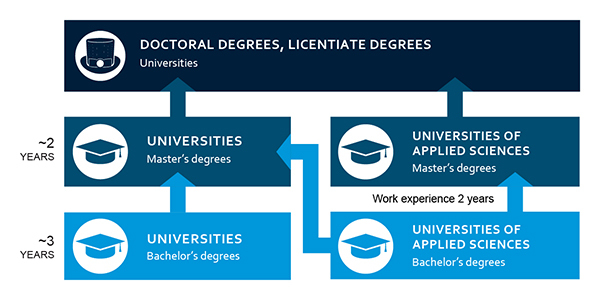
The Finnish education system has no dead-ends. Learners can always continue their studies on a higher level of education, whatever choices they make in between. Learn more about the Finnish education system (StudyInFinland.fi)
Read the students' stories
Laurea rewards excellence with separate study right for Master's degree studies
Students who complete their Bachelor's degree within the target time and with at least good grades will be granted separate study rights for Master's degree studies.
Read more
Master's Degree Path Studies
The path studies concept is used to refer to a study entity completed at an open university of applied sciences in a goal-oriented manner before seeking education leading to a degree
Learn more about path studies
Master's level studies at an open university of applied sciences
Laurea's continuing education online store Smart offers a wide range of Master's level studies.
Explore our study offerings
Separate applications
Separate applications are usually organized for applicants who have already completed their studies, for example at an open university of applied sciences or another university.
Learn more